
Monday, July 30, 2012


Sunday, October 23, 2011
Monday, August 29, 2011
Aaron Greenspan:mobile face cash payments
Aaron Greenspan: During my freshman year, I studied facial recognition in a seminar with Professor Ken Nakayama, who does research in Harvard’s Psychology Department. One of the things that struck me was how incredibly fast most people–(“most” because there is a tiny percentage of the population that suffers from a disease called prosopagnosia)–are able to recognize faces. It doesn’t matter what language you speak, how much education you’ve been able to complete, or generally how old you are; facial recognition is just one of those things we have evolved to be able to do incredibly quickly and relatively inexpensively, meaning that it requires almost no conscious effort. All of these facts combined make it a really good method for identity verification, when combined with some other security tokens such as a PIN number and e-mail address. What we have *not* evolved to be able to do is recognize the handwriting of other people–and of course that’s how identity verification (barely) works in the payment industry today.
Monday, August 22, 2011
fold of your wish
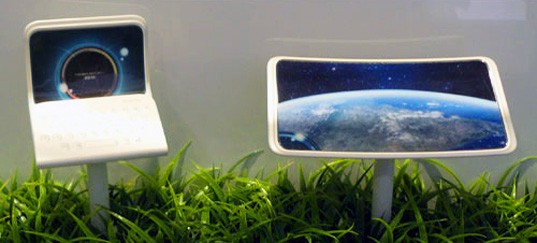

Kyocera's EOS folding concept phone incorporates a flexible OLED screen, changing its form factor from a clamshell into something more closely resembling a wallet or clutch-purse. Explains Kyocera industrial designer Susan McKinney:
The concept Eos envisions a future where we have a more humanistic relationship with our phones. Appealing to our haptic senses, a soft, semi-rigid polymer skin surrounds a flexible OLED display. The metaphor of a "living" skin was used for its notions of protection and constant evolution, providing a heightened user experience.
Shape memory allows keys to morph up from its surface when needed and fade away when not in use. The flexibility of the screen allows for greater adaptability of form and interaction it maintains a compact shape (the size of a small wallet) for simple phone calls, and unfolds to reveal a large widescreen display. The device feeds off of our physical interaction with it, translating kinetic energy into an electric charge via an array of nano-scale piezoelectric generators. The more we interact with Eos, the more energy it creates - without using batteries.
Though the Kyocera future concepts are still in their early design stages, the design teams from San Diego and Bangalore are exploring many different ways and possibilities of infusing some of the concept ideas into their near future lineup of phones and devices.
ALL IN ONE
GSM, CDMA, Wi-Fi, WiMax: Can't we all just get along? With IMS (IP Multimedia Subsystem), we just might. Now in trials, IMS network technology will allow any type of packet data--voice calls, video, music, HTML, you name it--to move seamlessly between IMS-enabled networks. With IMS, you'll be able to start a call on your cell phone and end it on a VoIP landline, watch pay TV on either a handset or a big screen (smart-card technology identifies you), and access your contacts from any connected PC or handset. But the benefits will kick in only once IMS is widely deployed, which will take several years.
Is there any end to these? : answer is always 'NO'


Today's mobile phones can already send e-mail, browse the Web, and keep you in touch with friends and colleagues via voice or text message. Tomorrow's handsets will add even more to the menu, morphing (as needed) into always-connected portable game consoles, full-featured TVs, and credit cards. Here's a quick look at what's coming:
Networks: In the next few years, cell phone networks will move data at several megabits per second, and will coexist with WiMax, Wi-Fi, and, for TV, DVB-H or MediaFLO. IMS will let them work together.
Handsets: Look for sleek designs (such as Frog Design's Ubik), better battery life, e-payment support, and graphics muscle for true TV and console-style video gaming.
Cameras: Expect not just high resolutions (8 megapixels and beyond), but also the same image-processing capabilities found in current digital still and video cameras.
Sunday, August 21, 2011
black berry dream in link with automobile


Knowing that QNX, which is at the core of the PlayBook's Tablet OS, is also running the computers in dozens of car manufacturers these days, it made sense to connect the dots and go there - this would be a BlackBerry addict's dream come true. Take a look at the photo below, and you'll see this isn't dream, but also one of the many potential visions QNX has for the future of mobile technology in automobiles.
QNX has a big footprint in automotive, already being utilized in over 200 automobile models (they're pretty much in every German-manufactured automobile and many, many more) and they're continuing to grow in this area.
In the past, in-car automobile technology has typically lagged consumer electronics by a pretty big margin, but it's clear that car manufacturers want to change that. QNX is already starting to see this happen in their workflow. In the past, car companies would typically work four years ahead on their models (think 2010 models being developed in 2006), with the electronics locked down - once a car hits the market you don't see the computer software get upgraded.
But already automotive is starting to move much faster, as more and more it's becoming what you can do in your car that's as important a selling feature as horsepower, fuel mileage, body style historically have been. With automotive wanting to keep up with the consumer market, the manufacturer's lead time from concept to reality on the electronics/infotainment/computers is becoming much shorter (think as fast as a year vs. 3-4 years).
Saturday, August 20, 2011
google's big bet on the mobile future
Google made a $12.5 billion bet on its future — and the future of big Internet companies — lies in mobile computing, and moved aggressively to take on its arch rival Apple in the mobile market.
The Silicon Valley giant, known for its search engine and Android phone software, rattled the tech world with its announcement that it would acquire Motorola mobility Holdings, allowing it to get into the business of making cellphones and tablets.
The acquisition, Google’s largest to date and an all-cash deal, would put the company in head-to-head competition with its own business partners, the many phone makers that use Android software, as well as with Apple.
Under the terms of the deal, which is expected to close by early 2012, Google will pay Motorola Mobility’s shareholders $40 a share, a 63 percent premium to Friday’s closing price. Although Motorola had casual talks with prospective suitors earlier this year, the sale of the Nortel patents at a $4.5 billion price tag encouraged Motorola’s directors to pursue a sale more actively, according to people briefed on the matter. Google, led by Mr. Page, emerged as the front runner, Motorola’s board gave the green light.
Shares of Google fell 1.16 percent on Monday, to $557.23, while shares of Motorola Mobility added 55.78 percent, to $38.12.
Friday, August 19, 2011
fujitsu concept phones


Fujitsu seems to be a staunch believer in the saying that more is better. The company showed off a dual-touchscreen smartphone concept at CEATEC 2010. Seeing it in action, it’s not that far out, allowing for portrait and landscape view via a handy “swing action” feature.The screens are quite narrow, so landscape view is indeed the best way to make the most out of this phone.Both screens seem responsive, but if I had this phone I don’t think I’ll ever get used to the huge gap in the middle. It would be better if the screens extended to the edges of the phone, and if you could split the phone in two for two-player gaming.
winner of istanbul design week 'packet phone'

Packet is the winner of Istanbul Design Week 2007 where it won the first place for this concept phone.
It is a cell phone concept that measures 5 cm x 5 cm, about half cigarette package when folded and when opened it reveals 5 surfaces with the keypad, display, 2 mini keyboards with letters, and the center face with touch-sensitive button areas.
In fact, the entire cell phone is made of a material similar with the e-paper and is touch-sensitive.
On the back it shows the time in large character format.
Packet is extremely thin and lightweight, easy portable and would probably be made of eco-friendly materials
ORGANIC LEAF PHONE


Leaf Phone is designed as an integral part of your activity: due to communicator and mini PC as well as flexible elements connecting its two parts the phone is getting an attractive and multi-purpose accessory. Smart phone adapts to the dynamics of human muscles, releasing him from the discomfort.
Due to this, the phone can be fixed in any position and at any part of the body.
The material for the surface is designed to accumulate solar energy.
ALEKSANDER MUKOMELVOS MOBILE SCRIPT

Maybe love at first sight is something you have never experienced. Your friends have told you about it, your parents have stories about it, but you have never felt that instant rush of blood to your heart.
So maybe if you have never experienced it, you won't know whether to believe in it or not. But all this doubt would be lain to rest as our heart beats faster… your pupils dilate…when do you finally experience love at first sight. Which is how I felt when I looked at the Mobile Script – a futuristic mobile phone designed by Russian industrial designer Alexander Mukomel.
Then you have experienced love at first sight and now you wish to express your love to this beautiful piece of design by possessing it. However, that will have to wait, as the Mobile Script is a conceptual mobile phone still in the process of development.
Neatly tucked under the standard display of the phone is a flexible OLED display (9.5 inches) that stiffens when ejected from the phone. This dramatically increases the viewing and working area of the phone. The flexible display is ideal to watch videos, type emails, write and edit documents, and surf the web.
A problem (if you consider it one) with present day mobile technology is the battery which can only be charged through a DC outlet. If you run out of battery with no access to a DC outlet, your mobile is as good as trash.
But with the advanced Mobile Script phone, you will never run out of battery. The futuristic phone comes covered with a sunlight sensitive nano material that harnesses solar power and uses it as energy to power the mobile.
Mobile Script is the future of mobile phone technology. A future where in all technology would be combined into a single device, which can be carried around in your pocket.
Thursday, August 18, 2011
NOKIA AEON
DETAILS OF NOKIA AEON
| 2G Networks | GSM 850/900/1800/1900 MHz |
| 3G Networks | HSDPA 900/2100 MHz |
| Announced | NA |
FormatNokia Aeon | |
| Form Factor | Bar |
| Dimensions (mm) | 0x0x0 |
| Weight (gms) | N/A |
DisplayNokia Aeon | |
| Type | TFT |
| Resolution | 240x320 pixels |
| No. of Colors | 16000000 |
| Size | 0.0 in |
| Scratch Resistant Display | |
| Multitouch | |
| Accelerometer | |
RingtonesNokia Aeon | |
| Type | Polyphonic (64 channels), Monophonic, True Tones, MP3 |
| Vibration | |
MemoryNokia Aeon | |
| Phonebook | Practically unlimited entries and fields, Photocall |
| Call Records | Detailed, max 30 days |
| Internal Memory | NA |
| Card Slot | Yes |
BatteryNokia Aeon | |
| Type | Li-Ion 1200mAH (BL-6F) |
| Stand-by | Up to 0.00hrs |
| Talk time | 0 hrs 00 min |
Internet & ConnectivityNokia Aeon | |
| Bluetooth | V2.0 |
| EDGE | True |
| Infrared Port | |
| WAP | 2.0/xHTML, HTML |
| GPRS | Class 32, 107 / 64.2 kbps |
| USB port | |
| GPS | |
| AGPS | |
| Wireless LAN | - |
EntertainmentNokia Aeon | |
| Games | Downloadable |
| Voice Recording | |
| MP3 Player/Support | |
| Video Player | |
| Audio 3.5 Jack | |
CameraNokia Aeon | |
| Camera MP | 5.0 |
| Max. Photo Resolution | 2592 x 1944 |
| Max. Video Resolution | - |
| Camera Flash | LED |
| Digital Zoom | N/A |
| Optical Zoom | N/A |
| Sec. Camera for Video Call | |
| Geo-Tagging | |
| Face Detection | |
| Smile Detection | |
| Auto Focus | |
MessagingNokia Aeon | |
| Supported Services | SMS, MMS, Email, Instant Messaging |
| QWERTY Keyboard | False |
| T9 Dictionary | |
Other FeaturesNokia Aeon | |
| Data Speed | NA |
| Clock | |
| Alarm | |
| Sense UI | |
| Handwriting Recognition | |
| Trackball | |
| CPU | - |
| Other | - |
| Colors | Green with Combination of Silver |
| Torch/Light | |
| Image Viewer/Organiser | |
| Java | MIDP 2.0 |
| Operating System | Symbian OS 9.2, S60 rel. 3.1 |
| Organiser | |
| Accessories | Charger, Handsfree, USB Cable |
| Language | English |
| Voice Memo | |
| Hands Free | |
| HSCSD | |
| Calendar | |
| Sync | |
| Sync ML | |
| Office Applications | |
| Voice Dial | |
FUTURE CELL PHONE INNOVATIONS


1)SUPER FAST CHARGE:
Thanks to insufferably smart MIT people who have been playing with lithium-ion technology, charge time in the future is likely going to be reduced to mere seconds. No kidding.
Apparently we’re living in the lithium-ion stone age right now, as current charging involves moving around those actual lithium ions like they’re elderly mall walkers. You can’t rush that, it just won’t work. But with some tinkering, the plan is to put super speedways inside the batteries that allow the ions to fly to where they need to be at high speeds. As an added bonus, the change in technology will significantly cut back on the recharge wear and tear that causes batteries to crap out over time.
Best of all, the technology isn’t really space age and new, it’s just a modification on existing technology, meaning they’re expecting it to be available fairly soon – like within the next couple of years.
2)MORPHING
If battery life and charging is the biggest problem your cell phone faces today, the second biggest problem, at least for those of us who tend to break things a lot, is, you know, breaking it. Phones are tough, but every so often you accidentally drop one on the floor, or your dog tries to eat it, or someone sits on it while it’s open and then you’ve got some decorative, high-priced garbage sitting around.
The future is looking bright for the unsteady of hand, however, with some concept phones like the NEC tag phone from a couple of years back. Made of a rubber-like “shape memorizing” material, the tag is kind of like those view screens they pull out on sci-fi shows all the time now – it’s bendy, flexible technology. If you want to roll it up in a ball, you’re perfectly alright to do so. If you want to fold it and put it in your pocket like a wallet, that’ll work too.
Nokia is working on nanotechnology products to create the Morph phone – phones which can be disguised as just about anything, twisted and bent into different shapes, make use of nearly invisible technology so you can actually see through them, self-cleaning materials and solar technology.
3)BOARDING PASS
Sure, most of us enjoy any extra hassles we can go through at airports, because flying is generally far too pleasant an experience these days. Still, some people are actually trying to make it even more convenientContinental was the first airline to try out the entirely electronic boarding system, sending boarding passes to phones complete with a 2-D barcode that can be scanned to allow passengers on planes. The advantages here are that you don’t have to worry about printing your own boarding pass, losing your boarding pass and odds are if you forget everything, you’ll still have your phone so you won’t miss your flight. And the bar codes on cell phones are harder to forge than one dimensional bar codes on paper passes, so it sticks it to counterfeiters.
An added bonus to the paperless method is the ease with which the airlines can stop ruining your life. If the flight is overbooked, that can be worked out without you wasting time. If they have no more kosher meals, if you want to upgrade your seating or if they only have diet Tab cola, you can get in touch with one another with ease.
Subscribe to:
Posts (Atom)