Monday, August 29, 2011
Aaron Greenspan:mobile face cash payments
Aaron Greenspan: During my freshman year, I studied facial recognition in a seminar with Professor Ken Nakayama, who does research in Harvard’s Psychology Department. One of the things that struck me was how incredibly fast most people–(“most” because there is a tiny percentage of the population that suffers from a disease called prosopagnosia)–are able to recognize faces. It doesn’t matter what language you speak, how much education you’ve been able to complete, or generally how old you are; facial recognition is just one of those things we have evolved to be able to do incredibly quickly and relatively inexpensively, meaning that it requires almost no conscious effort. All of these facts combined make it a really good method for identity verification, when combined with some other security tokens such as a PIN number and e-mail address. What we have *not* evolved to be able to do is recognize the handwriting of other people–and of course that’s how identity verification (barely) works in the payment industry today.


Monday, August 22, 2011
fold of your wish
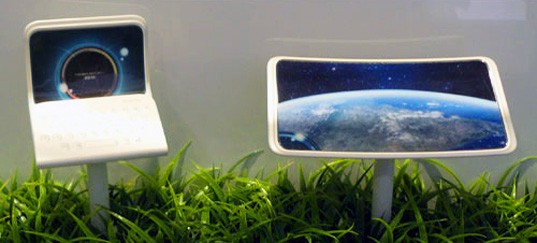

Kyocera's EOS folding concept phone incorporates a flexible OLED screen, changing its form factor from a clamshell into something more closely resembling a wallet or clutch-purse. Explains Kyocera industrial designer Susan McKinney:
The concept Eos envisions a future where we have a more humanistic relationship with our phones. Appealing to our haptic senses, a soft, semi-rigid polymer skin surrounds a flexible OLED display. The metaphor of a "living" skin was used for its notions of protection and constant evolution, providing a heightened user experience.
Shape memory allows keys to morph up from its surface when needed and fade away when not in use. The flexibility of the screen allows for greater adaptability of form and interaction it maintains a compact shape (the size of a small wallet) for simple phone calls, and unfolds to reveal a large widescreen display. The device feeds off of our physical interaction with it, translating kinetic energy into an electric charge via an array of nano-scale piezoelectric generators. The more we interact with Eos, the more energy it creates - without using batteries.
Though the Kyocera future concepts are still in their early design stages, the design teams from San Diego and Bangalore are exploring many different ways and possibilities of infusing some of the concept ideas into their near future lineup of phones and devices.
ALL IN ONE
GSM, CDMA, Wi-Fi, WiMax: Can't we all just get along? With IMS (IP Multimedia Subsystem), we just might. Now in trials, IMS network technology will allow any type of packet data--voice calls, video, music, HTML, you name it--to move seamlessly between IMS-enabled networks. With IMS, you'll be able to start a call on your cell phone and end it on a VoIP landline, watch pay TV on either a handset or a big screen (smart-card technology identifies you), and access your contacts from any connected PC or handset. But the benefits will kick in only once IMS is widely deployed, which will take several years.
Is there any end to these? : answer is always 'NO'


Today's mobile phones can already send e-mail, browse the Web, and keep you in touch with friends and colleagues via voice or text message. Tomorrow's handsets will add even more to the menu, morphing (as needed) into always-connected portable game consoles, full-featured TVs, and credit cards. Here's a quick look at what's coming:
Networks: In the next few years, cell phone networks will move data at several megabits per second, and will coexist with WiMax, Wi-Fi, and, for TV, DVB-H or MediaFLO. IMS will let them work together.
Handsets: Look for sleek designs (such as Frog Design's Ubik), better battery life, e-payment support, and graphics muscle for true TV and console-style video gaming.
Cameras: Expect not just high resolutions (8 megapixels and beyond), but also the same image-processing capabilities found in current digital still and video cameras.
Sunday, August 21, 2011
black berry dream in link with automobile


Knowing that QNX, which is at the core of the PlayBook's Tablet OS, is also running the computers in dozens of car manufacturers these days, it made sense to connect the dots and go there - this would be a BlackBerry addict's dream come true. Take a look at the photo below, and you'll see this isn't dream, but also one of the many potential visions QNX has for the future of mobile technology in automobiles.
QNX has a big footprint in automotive, already being utilized in over 200 automobile models (they're pretty much in every German-manufactured automobile and many, many more) and they're continuing to grow in this area.
In the past, in-car automobile technology has typically lagged consumer electronics by a pretty big margin, but it's clear that car manufacturers want to change that. QNX is already starting to see this happen in their workflow. In the past, car companies would typically work four years ahead on their models (think 2010 models being developed in 2006), with the electronics locked down - once a car hits the market you don't see the computer software get upgraded.
But already automotive is starting to move much faster, as more and more it's becoming what you can do in your car that's as important a selling feature as horsepower, fuel mileage, body style historically have been. With automotive wanting to keep up with the consumer market, the manufacturer's lead time from concept to reality on the electronics/infotainment/computers is becoming much shorter (think as fast as a year vs. 3-4 years).
Subscribe to:
Posts (Atom)